



More Coverage


Twitter Coverage

JOIN SATYAAGRAH SOCIAL MEDIA


"यूँ तो मैं, दिखलाता नहीं, तेरी परवाह करता हूँ मैं माँ": In a Dharmapuri matricide, 20-year-old Devaraj brutally bludgeoned his mother Chinnapappa to death with an iron rod over a crippling bail debt, exposing the deeply flawed state justice system

The horrific killing of a 45-year-old mother by her 20-year-old son in Dharmapuri, Tamil Nadu, has laid bare the fragile intersections of rural poverty, the criminal justice system, and the state's escalating political war over law and order.
The tragedy, which occurred in late October 2026, is not merely a localized domestic dispute that ended in bloodshed. It is a damning indictment of the systemic failures that surround first-time young offenders, the crushing debt burdens placed on rural women navigating the bail system, and the absence of adequate psychiatric intervention for troubled youth.
By deconstructing the events in a reverse chronological framework—from the immediate political and criminal aftermath back to the socio-economic precursors of the crime—this report investigates how a mother's desperate attempt to secure her son's freedom culminated in her own violent death, and what this singular event reveals about the broader crisis of family violence and youth rehabilitation in India.
|
The Aftermath: Political Crossfire and Statistical Realities (Late October – November 2026)
In the immediate weeks following the murder of S. Chinnapappa, the tragedy was rapidly absorbed into a volatile political narrative regarding Tamil Nadu's deteriorating law and order. The incident became a focal point in a statewide debate over youth crime, narcotics, and the efficacy of the ruling government.
The Weaponization of a Domestic Tragedy
The political discourse surrounding the Dharmapuri matricide was spearheaded by opposition leaders who sought to frame the incident as a symptom of a broader administrative collapse under the current regime, led by Chief Minister C. Joseph Vijay of the Tamilaga Vettri Kazhagam (TVK). Leader of the Opposition and DMK leader Udhayanidhi Stalin launched a scathing attack in the Tamil Nadu Assembly, linking the Dharmapuri case to a recent spate of violent crimes, including the brutal hacking of a 19-year-old Dalit student named Amudhan in Coimbatore, and the murder of a history-sheeter in Sivaganga.
Stalin explicitly criticized the Chief Minister's recent anti-drug initiatives, mocking the government's newly launched awareness slogan, "Sports-ah Edu, Drugs-ah Vidu" (Take up sports, quit drugs). "The government said they are against drugs, but murders are happening," Stalin argued, asserting that systemic negligence and police apathy were costing lives across the state, particularly among vulnerable populations and marginalized castes.
Similarly, AIADMK General Secretary Edappadi K. Palaniswami (EPS) leveraged the incident to question the operational effectiveness of the state police. Pointing to a perceived surge in violent crimes, EPS demanded stringent legal action and detailed investigations into the root causes of youth violence, asserting that the state's failure to curb the drug menace was putting the youth of Tamil Nadu at severe risk and creating a scenario of "murder everywhere, always".
The Statistical Context of Violence in Tamil Nadu
While the political rhetoric focused heavily on systemic administrative failures and the drug trade, it largely bypassed the intimate, socio-economic intricacies of the Dharmapuri case. However, the politicians' claims regarding rising crime do possess a statistical grounding that cannot be ignored.
Recent data from the National Crime Records Bureau (NCRB) illustrates a complex landscape of violence in the state. Tamil Nadu recently recorded a crime rate against women of 29.4 per lakh population. Crucially, "cruelty by husband and relatives" continues to be the largest category of registered crimes against women nationally, accounting for over 27% of cases (more than 1.20 lakh cases in recent annual data). Furthermore, in 96.8% of severe assault and rape cases, the perpetrator is known to the victim—most often a family member or intimate partner.
The state has also witnessed a 27.9% spike in crimes against children and Dalits in recent years, alongside fluctuating rates of violent crimes such as murder. Against this backdrop, the Tamil Nadu police have intensified their narcotics enforcement. In July 2026 alone, special enforcement drives resulted in the seizure of hundreds of kilograms of ganja and the registration of over 1,000 cases under the Narcotic Drugs and Psychotropic Substances (NDPS) Act. Yet, despite these seizures, the infiltration of narcotics into rural youth demographics remains a persistent catalyst for domestic instability.
| Crime Metric (Tamil Nadu / National Context) | Verified Data Point | Key Implication |
| Crime Rate Against Women | 29.4 per lakh population (TN). | Indicates a significant, mid-range national vulnerability for women in the state. |
| Cruelty by Relatives | Accounts for 27% of all crimes against women nationally. | Domestic environments remain the most statistically dangerous spaces for women. |
| Perpetrator Familiarity | Perpetrators known to victims in 96.8% of severe assault cases. | Highlights the intimate nature of violence, aligning with the matricide tragedy. |
| NDPS Enforcement | Over 1,020 cases detected and 1,034 kg of ganja seized in a single month (July 2026). | Underscores the heavy presence of the drug trade, fueling political narratives around youth crime. |
The Investigation and Legal Classifications (October 30, 2026)
On Friday, October 30, 2026, the Indur police formally recorded the arrest of 20-year-old S. Devaraj in connection with the brutal murder of his mother. The arrest followed a rapid response by local authorities to the family's residence in Palaya (Old) Indur, where officers recovered the victim's body and transported it to the Dharmapuri Government Medical College Hospital for a post-mortem examination to establish the exact etiology and severity of the blunt-force trauma.
In the immediate wake of the murder, local media and public speculation heavily linked the violence to substance abuse, specifically alleging that Devaraj was in a state of severe ganja intoxication during the attack. However, Dharmapuri District Superintendent of Police (SP) A.K. Arun Kabilan swiftly moved to address these claims, providing critical clarifications based on preliminary investigations. SP Kabilan stated definitively that while earlier reports had tied the incident to ganja consumption, no forensic or investigative evidence had emerged to prove that Devaraj was under the influence of narcotics at the exact time of the murder.
According to the Superintendent's official statement, the trigger for the violence was rooted in a domestic dispute over finances and behavioral reform, not drug-induced psychosis. "Preliminary inquiries indicated that Chinnapappa had questioned Devaraj about his behaviour and advised him to reform himself. This angered Devaraj, who suddenly attacked her with an iron rod, inflicting fatal injuries on her," SP Kabilan noted.
The accused was subsequently booked for murder under Section 103 of the newly implemented Bharatiya Nyaya Sanhita (BNS), 2023. Section 103 of the BNS—which replaced Section 302 of the Indian Penal Code (IPC)—mandates that whoever commits murder shall be punished with death or imprisonment for life, and shall also be liable to a fine. Because the act involved direct intention and brutal execution without any mitigating exceptions (such as grave and sudden provocation or the right of private defense, which would reduce the charge to culpable homicide under Section 105), the charge holds the maximum judicial weight, rendering it a non-bailable, cognizable offense triable exclusively by a Court of Session.
The Dharmapuri Tragedy: A Timeline of Escalation
| Date | Event | Details |
| Aug 3, 2026 | Initial Arrest | Devaraj arrested in Indur for public nuisance and armed threats. |
| Oct 28, 2026 | Release on Bail | Secured bail after his mother paid a ₹50,000 bond. |
| Oct 29, 2026 | The Altercation and Murder | Argument over money and reform ends in the fatal assault of Chinnapappa. |
| Oct 30, 2026 | Police Action | Indur Police arrest Devaraj and recover the weapon. |
| Nov 2026 | Political Fallout | Statewide debate erupts over law, order, and youth crime. |
The Fatal Night: Debt, Defiance, and Domestic Violence (October 28–29, 2026)
To comprehend the sheer brutality of October 29, one must examine the immediate precursors following Devaraj's release from the Salem Central Prison. The timeline of his freedom and his mother's murder spans less than 48 hours, highlighting a disastrous re-entry into a highly volatile domestic environment.
The Burden of the Bail Bond
On Wednesday, October 28, 2026, Devaraj walked out of judicial custody after securing bail. His release was entirely contingent on the extraordinary financial lengths his mother, Chinnapappa, undertook. To meet the bail requirements, she deposited ₹50,000 towards the surety bond. In a district characterized by severe agrarian distress and informal labor, raising this amount was a monumental task for a coolie and homemaker.
Her husband, Sithan (50), a construction mason, and her older son were away working in Bengaluru at the time. This geographic splintering of the family is a common pattern of distress migration in Dharmapuri, where frequent crop failures, climate volatility, and a lack of local industrial employment force men to migrate to urban centers as casual laborers, leaving the women behind to manage the household and local crises.
Left alone to manage her younger son's legal crisis, Chinnapappa was forced to borrow the ₹50,000 from informal sources, plunging the family into a precarious debt trap. The dynamics of this debt cannot be overstated; in rural Tamil Nadu, women frequently bear the brunt of informal borrowing. Organizations like the All India Democratic Women's Association (AIDWA) have extensively documented how rural women are pressured by microfinance institutions, private moneylenders, and pawn brokers, often leading them to pawn their last remaining jewelry or face coercive collection mechanisms. When confronted with a sudden legal emergency—such as securing a son's bail—these women have no choice but to take on toxic debt, the repayment of which dictates their daily survival and induces profound psychological stress.
The Escalation and the Iron Rod
Upon his return to their home in Old Indur, the tension surrounding this financial sacrifice immediately surfaced. On the evening of Thursday, October 29, just a day after his release, Chinnapappa confronted Devaraj. According to police reconstruction based on preliminary inquiries, she advised her 20-year-old son to abandon his destructive lifestyle, secure steady work, and stay out of further legal trouble. Crucially, she reminded him of the severe financial toll his actions had taken on the family, specifically citing the massive sum borrowed to secure his freedom.
Rather than showing remorse, Devaraj took extreme offense to her admonition. He argued vehemently, insisting that no one, including his mother, had the right to question his autonomy or behavior. The psychological profile of the youth at this moment—fresh out of a three-month stint in a central prison, likely dealing with the shock of re-entry, and reacting with hyper-defensiveness to parental authority—created a highly combustible environment.
At approximately 10:30 PM to 11:30 PM, the argument reached its fatal climax. Devaraj bolted the door of the house from the inside, trapping his mother. He then seized an iron rod—a heavy, lethal tool likely present in the home due to the family's background in construction and masonry—and launched a frenzied, repeated assault on Chinnapappa. The victim sustained catastrophic blunt-force trauma to the head and died on the spot.
The fact that the father and older brother were in Bengaluru at the time left Chinnapappa utterly isolated, removing any physical deterrent, male authority figure, or mediating presence that might have de-escalated the confrontation.
|
The Systemic Void: Undertrials, Legal Aid, and the BNSS 2023 (August – October 2026)
The financial mechanics of Devaraj's release illuminate a glaring disconnect between legislative intent and ground reality in India's criminal justice system. If the legal framework had functioned as intended, Chinnapappa might never have had to incur the ₹50,000 debt that served as the catalyst for her murder.
The Promise of Section 478 BNSS
In mid-2024, India transitioned from the Code of Criminal Procedure (CrPC) to the Bharatiya Nagarik Suraksha Sanhita (BNSS), 2023. A cornerstone of the BNSS regarding bail is Section 478 (corresponding to the old Section 436 CrPC), which governs bail in bailable offenses and specifically addresses the plight of indigent undertrials.
Under the proviso to Section 478 BNSS, if a person is indigent and unable to furnish a surety, the court shall release them on their execution of a personal bond without sureties. Furthermore, the statute explicitly includes an explanation stating that if a person is unable to give a bail bond within a week of their date of arrest, it constitutes a "sufficient ground for the officer or the Court to presume that he is an indigent person". This legislative shift was designed explicitly to decouple poverty from prolonged pretrial detention, ensuring that individuals do not languish in jail merely because they cannot afford to buy their freedom.
Devaraj spent nearly 90 days in custody as an undertrial (August 3 to October 28). By all statutory definitions under the BNSS, his inability to secure bail in the first week should have triggered a presumption of indigence, theoretically mandating his release on a personal bond to prevent prolonged detention. Yet, the reality was starkly different. The system demanded a surety, and his mother had to eventually borrow and deposit a staggering ₹50,000 to secure his release.
The Failure of Legal Aid Infrastructure
This scenario exposes a critical failure in the implementation of state-sponsored legal aid. The Tamil Nadu State Legal Services Authority (TNSLSA) and the District Legal Services Authorities (DLSA) are legally mandated under the Legal Services Authorities Act, 1987, to provide free legal aid to marginalized individuals, women, and indigent prisoners.
The National Legal Services Authority (NALSA) has established Standard Operating Procedures for the representation of persons in custody, mandating the creation of Prison Legal Aid Clinics (PLACs) in every central and district prison. These clinics, staffed by Jail Visiting Lawyers (JVLs) and Para Legal Volunteers (PLVs), are supposed to interact with inmates, identify those unable to furnish bail, and move applications for their release on personal bonds.
The fact that Devaraj sat in Salem Central Prison for three months and that his mother ultimately had to resort to toxic, high-interest informal borrowing to pay a surety bond suggests a severe breakdown in the penetration of these legal aid services. When legal aid fails to proactively identify and assist an indigent undertrial, the punitive weight of the justice system is transferred directly onto the shoulders of the family—most often the women, who are forced to navigate the predatory informal credit markets.
The Prelude: Performative Violence and the Criminology of Matricide (August 2026)
The murder was not an isolated snap of violence, but the tragic culmination of a behavioral trajectory that had become visible months prior. Devaraj's initial descent into the criminal justice system provides vital context regarding his psychological state, his relationship with authority, and the roots of his eventual homicidal actions.
The Sword Incident and Digital Machismo
On August 3, 2026, the Indur police arrested Devaraj following a bizarre and highly threatening public display. Acting in what sources described as an inebriated state, the youth donned the cap of a traffic police personnel and brandished a sword or large knife in the Indur suburban area. He terrorized passers-by, chasing them down the street, and specifically attempted to attack a local man identified as Veeramani.
Beyond the physical threat, the incident carried the distinct hallmark of modern youth delinquency: digital exhibitionism. Devaraj had reportedly recorded videos (reels) of himself wielding the weapon and shared them across social media platforms. This behavior points to a deep-seated desire for notoriety, a detachment from the gravity of violent threats, and a performative machismo fueled by peer validation online. Following a formal complaint, the police apprehended him, registering cases related to public nuisance and armed threats, and remanded him to judicial custody.
The Pathology of Parricide and Matricide
To understand how a son could bludgeon his mother to death, one must look beyond the immediate argument over money and examine the criminological and psychological foundations of parricide (the killing of a parent), and specifically matricide (the killing of a mother).
Matricide is a statistically rare event, generally accounting for less than 2% to 4% of all homicides globally. However, in India, while comprehensive standalone data on parricide is limited, the NCRB notes that family-related murders (disputes, domestic violence) form a significant chunk of violent crime.
Forensic psychiatric literature establishes clear typologies for matricide offenders. Overwhelmingly, the perpetrators are young, single males under the age of 30 who reside in the family home with the victim. Criminological studies frequently link these horrific acts to severe underlying psychopathology—most commonly schizophrenia, psychotic disorders, or severe antisocial personality traits—frequently complicated by comorbid substance abuse.
While SP Arun Kabilan noted there was no immediate evidence of ganja intoxication at the exact time of the murder, Devaraj's documented history of public inebriation, volatile behavior, and the local community's association of him with the drug trade cannot be ignored. Chronic substance abuse, particularly of high-potency cannabis or synthetic drugs, is clinically known to exacerbate latent psychological vulnerabilities, severely lower impulse control, and induce paranoia or hostility. The sudden transition from the highly structured, suppressive environment of a prison back to the unstructured, high-stress environment of an impoverished home often triggers acute dysregulation in young offenders.
The Anatomy of a Crisis: Converging Vectors in Parricide |
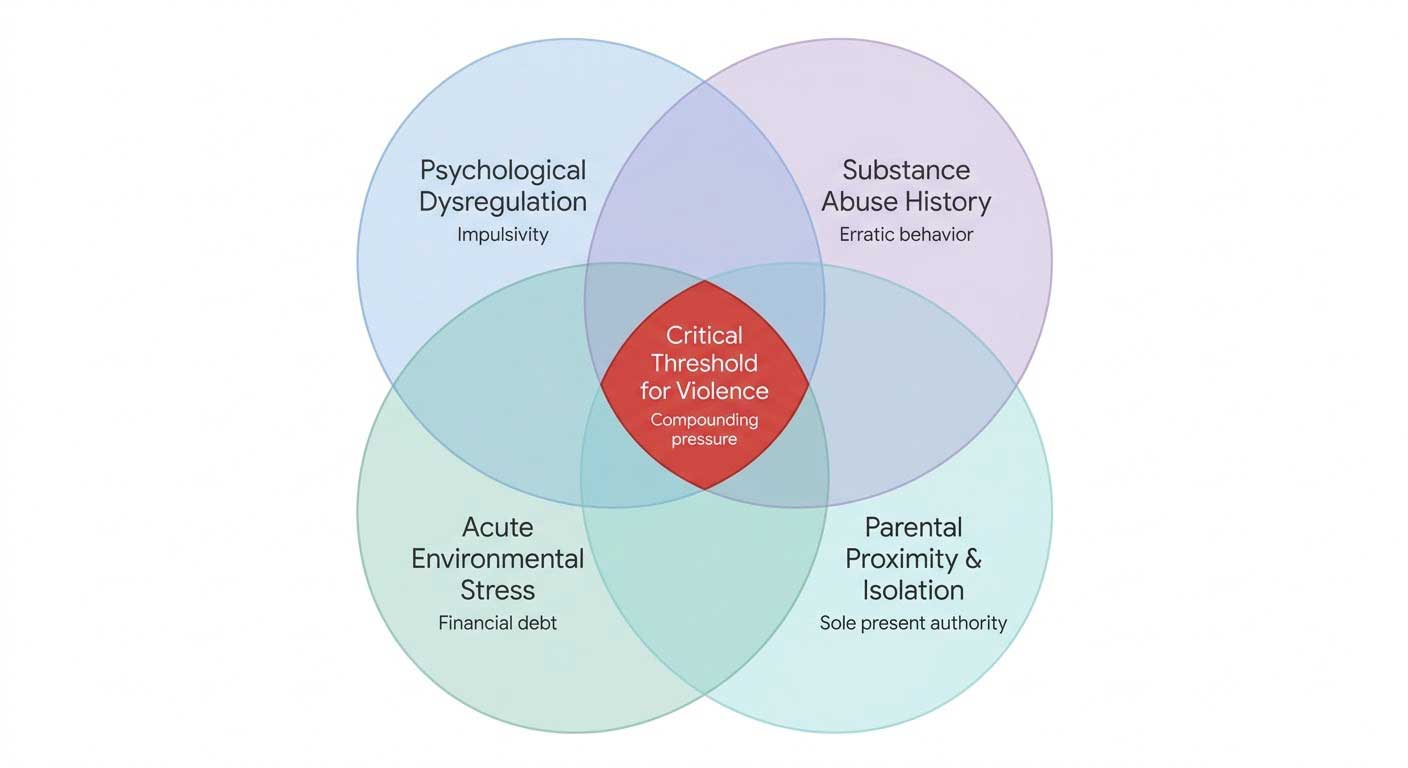 |
| Forensic psychiatric research indicates that fatal family violence rarely stems from a single cause. It is frequently the volatile outcome of overlapping psychological vulnerabilities, immediate environmental stressors, and the physical proximity of the caregiver. |
Parental Proximity and the Power Contest
Another critical concept in understanding this crime is "parental proximity." Research indicates that mothers are disproportionately the victims of parricide by sons simply because they are the primary caregivers, the most physically present authority figures, and often the ones attempting to enforce behavioral boundaries in dysfunctional households.
With Devaraj's father working in another state, Chinnapappa became the sole enforcer of family discipline. The altercation on October 29 was fundamentally a power contest. Chinnapappa, having leveraged the family's financial future to save her son, demanded compliance and reform. Devaraj, reacting with the hostility of an antisocial personality profile and a deep resentment of authority (previously demonstrated by his mockery of the police uniform and sword-wielding in public), rejected this power dynamic violently.
Furthermore, the use of "overkill"—repeated strikes with a heavy iron rod—is highly characteristic of parricide. Forensic studies note that parricides frequently involve excessive, destructive violence (often blunt force trauma), symbolizing a complete, frenzied psychological break and a desperate attempt to obliterate the source of perceived psychological pressure.
Structural Failures in Youth Rehabilitation: The PARAVAI Paradox
The tragedy in Dharmapuri highlights a fatal gap in how the state manages young men who brush against the law. Traditional incarceration merely pauses the trajectory of a troubled youth; it does not alter it. When Devaraj left the prison gates on October 28, there was no handover, no psychological evaluation, and no community support mechanism to aid his re-entry into a highly stressed household.
The Vacuum of Salem Central Prison
Devaraj's three-month detention in Salem Central Prison represents a critical missed opportunity for systemic intervention. Prisons in Tamil Nadu, including Salem, often struggle with overcrowding and house massive populations of undertrials who languish without access to targeted psychological counseling or vocational training.
While the Tamil Nadu Department of Prisons and Correctional Services has initiated several progressive reform measures, the reality for a short-term, 20-year-old undertrial in a district facility is often grim. Instead of receiving behavioral correction or substance abuse counseling, young first-time offenders in general prison populations are frequently exposed to hardened criminals, experiencing what criminologists refer to as the "contaminating atmosphere" of the penitentiary. The psychological distress of incarceration, combined with sudden release and the immediate confrontation regarding the financial cost of that release, created a pressure cooker scenario. The system succeeded in temporarily warehousing the youth, but utterly failed in rehabilitating him prior to his return to the family home.
The Unrealized Potential of PARAVAI
Ironically, Tamil Nadu possesses one of the most innovative policy frameworks in the country for preventing exactly this type of recidivism and family violence, though its implementation has historically been centered in urban hubs like Chennai rather than rural districts like Dharmapuri.
The PARAVAI (Personality Attitude Reformation Assistance Venture Affirming Identity) project, launched jointly by the Greater Chennai Police and the PRISM Trust, was specifically designed to address the needs of young, petty, first-time offenders (aged 18 to 24). Recognizing that the transition period—both during remand and immediately post-release—is the highest-risk window for re-offending, PARAVAI shifts the focus from punitive action to holistic rehabilitation.
The program operates on a structured, multi-departmental approach designed to intercept the exact vulnerabilities Devaraj exhibited:
Immediate Needs Assessment: Identifying psychological distress, substance abuse issues, or educational deficits while the youth is still in custody (complementing the in-prison 'PATTAM' psychological program).
Family Engagement: Social workers and police liaisons visit the family before release to assess the home environment, prepare the parents, and manage expectations, providing counseling to bridge the gap between the offender and the family.
Skill and Livelihood Training: Partnering with the Department of Employment and Training to funnel released youths directly into Industrial Training Institutes (ITIs) or job placements, giving them an immediate, constructive routine and an income source.
Drop-In Centers: Establishing safe spaces in the community where young offenders can receive continuous legal, cognitive, and socio-emotional counseling post-release from community social workers.
If a framework like PARAVAI had been deeply integrated into the rural policing and judicial infrastructure of Dharmapuri and Salem Central Prison, the outcome for Devaraj and Chinnapappa might have been vastly different. A pre-release family assessment would have flagged the massive debt Chinnapappa had incurred, alerting authorities to the high-stress environment Devaraj was entering. Post-release tracking and immediate induction into a vocational program could have provided the youth with the direction his mother so desperately wanted him to find.
Recently, the Madras High Court ordered the Tamil Nadu government to evaluate the expansion and strict implementation of the PARAVAI and PATTAM projects across all districts of the state. The Dharmapuri matricide serves as the bloodiest possible evidence for why these programs cannot remain confined to pilot stages in metropolitan areas; rural youth are just as susceptible to the lethal combination of idleness, substance abuse, and psychological dysregulation.
The Normalization of Domestic Violence
The failure to protect Chinnapappa also points to a broader societal apathy regarding violence within the home. Data from the fifth round of the National Family Health Survey (NFHS-5) for Tamil Nadu reveals deeply entrenched patterns of domestic abuse.
According to the NFHS-5 report, approximately 41.5% to 45.6% of women in Tamil Nadu between the ages of 18 and 49 have experienced either physical or sexual violence. While the most common perpetrator is an intimate partner or husband, the data underscores a cultural normalization of violence against women within the domestic sphere, often fueled by substance abuse and financial stress.
The state's 181 Women Helpline—designed to provide 24/7 crisis intervention, counseling, and rescue services for women facing domestic violence—is a vital resource. However, its efficacy is often limited by a lack of awareness in deeply rural pockets or the cultural stigma associated with reporting a family member to the authorities. Chinnapappa, facing an enraged son armed with an iron rod late at night, was trapped in a scenario where state rescue mechanisms were entirely out of reach.
Conclusion: Reframing the Narrative of Youth Crime
When a 20-year-old bludgeons his mother to death a day after she bankrupts herself to secure his freedom, it is easy for society and political actors to dismiss the perpetrator as an inherent monster, a symptom of moral decay, or merely collateral damage in a statewide drug war. The political shouting matches between the TVK, DMK, and AIADMK over crime statistics and policing failures, while relevant to public policy, often miss the localized, human realities of these tragedies.
The murder of Chinnapappa demands a much deeper reckoning. It exposes the cruelty of a bail system that, despite progressive legislative reforms like the BNSS 2023, still forces indigent families into the hands of predatory lenders due to the operational failures of legal aid infrastructure. It highlights the invisible epidemic of domestic violence and agrarian distress that isolates rural women, leaving them to manage volatile, un-rehabilitated youths without any institutional support. Finally, it screams for the universal application of reformative justice models like PARAVAI.
Warehousing a first-time youth offender in a central prison for three months and then releasing him blindly into a desperate, debt-ridden household is not justice; it is the manufacturing of a tragedy. Until the state bridges the gap between progressive rehabilitation policies and rural ground realities, the cycle of dysfunction will persist. True law and order will not be achieved merely by debating crime statistics on the assembly floor, but by actively dismantling the socio-economic and psychological traps that turn homes into crime scenes.
 Support Us
Satyagraha was born from the heart of our land, with an undying aim to unveil the true essence of Bharat. It seeks to illuminate the hidden tales of our valiant freedom fighters and the rich chronicles that haven't yet sung their complete melody in the mainstream.
While platforms like NDTV and 'The Wire' effortlessly garner funds under the banner of safeguarding democracy, we at Satyagraha walk a different path. Our strength and resonance come from you. In this journey to weave a stronger Bharat, every little contribution amplifies our voice. Let's come together, contribute as you can, and champion the true spirit of our nation.
 |  |  |
| ICICI Bank of Satyaagrah | Razorpay Bank of Satyaagrah | PayPal Bank of Satyaagrah - For International Payments |
If all above doesn't work, then try the LINK below:
DISCLAIMER: The author is solely responsible for the views expressed in this article. The author carries the responsibility for citing and/or licensing of images utilized within the text. The website also frequently uses non-commercial images for representational purposes only in line with the article. We are not responsible for the authenticity of such images. If some images have a copyright issue, we request the person/entity to contact us at This email address is being protected from spambots. You need JavaScript enabled to view it. and we will take the necessary actions to resolve the issue.


