


MORE COVERAGE


Top of broken pillar in foreground with the famous Sarnath lion capital standing on the ground beyond - 1905

Photograph of the Lion Capital at Sarnath, Uttar Pradesh, from the Kitchener of Khartoum Collection: 'Views of Benares. Presented by the Maharaja of Benares' by Madho Prasad, c.1905.
Sarnath is the sacred place where the Buddha preached his first sermon known as the Wheel of Law, the Dharmachakra, in the sixth century BC.
The Lion capital comes from a column at Sarnath in Uttar Pradesh, built by Ashoka, the Mauryan king who flourished in the third century BC. According to tradition, the pillars were raised at various points on the route of a pilgrimage that he undertook in the twentieth year of his reign.
The capital, which became the national emblem of India in 1950, is in a museum in Sarnath. The Lion capital is a polished sandstone carving of four lions atop an abacus (the slab forming the top of a column).
The lions are facing in four directions and on the abacus are eight images. Immediately below each lion is a dharma chakra, or wheel, with twenty-four spokes. This wheel has been incorporated into the national flag of India. Between the wheels are four animals – a lion, a horse, an elephant, and a bull. Falling from the abacus is an upturned, bell-shaped lotus flower.
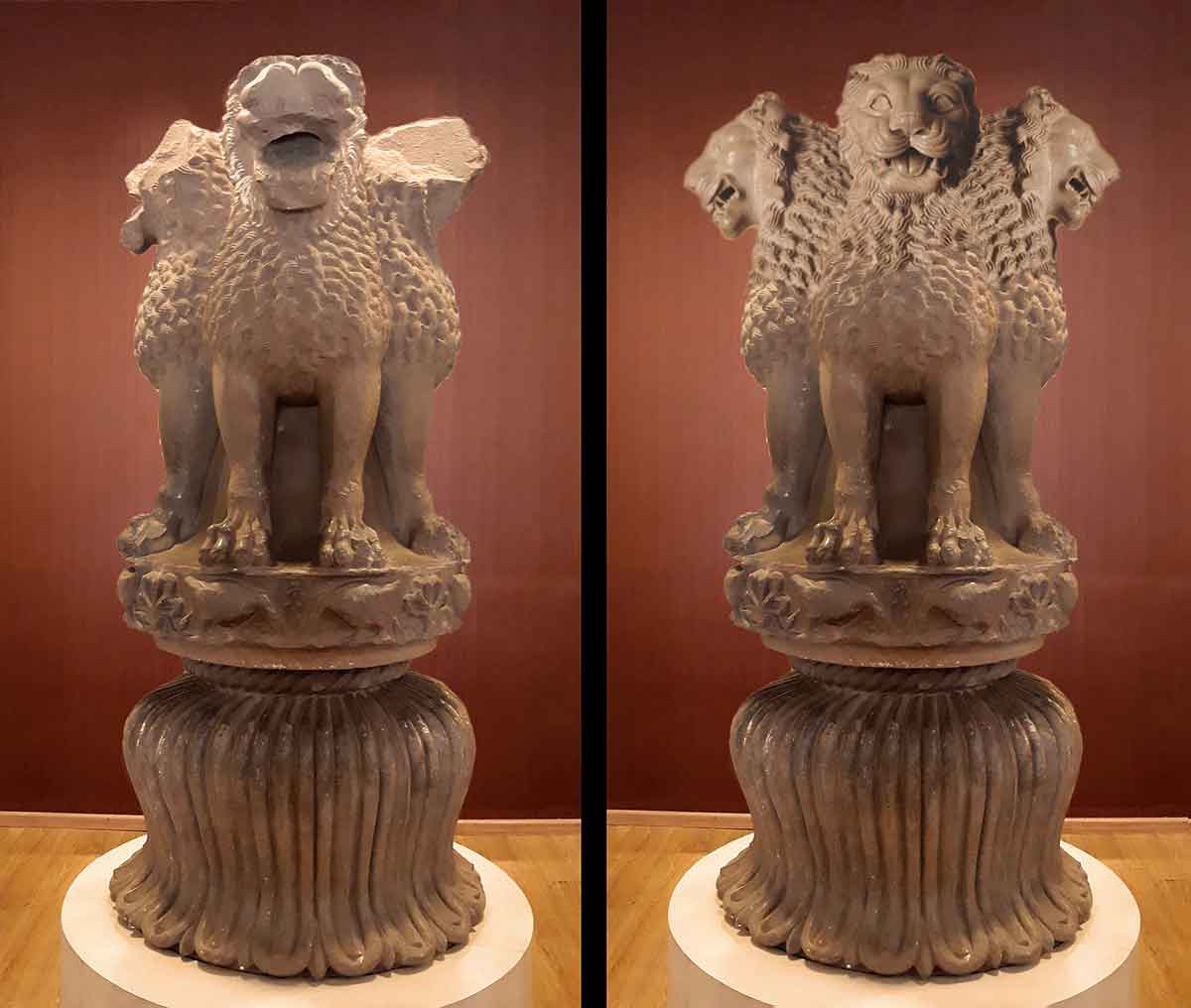 The capital of the Sanchi pillar of Ashoka, as discovered (left), and simulation of original appearance (right). Sanchi Museum. 250 BCE. |
Art history
Currently, seven animal sculptures from Ashoka pillars survive. These form "the first important group of Indian stone sculpture", though it is thought they derive from an existing tradition of wooden columns topped by animal sculptures in copper, none of which have survived. There has been much discussion of the extent of influence from Achaemenid Persia, where the column capitals supporting the roofs at Persepolis have similarities, and the "rather cold, hieratic style" of the Sarnath sculptures especially shows "obvious Achaemenid and Sargonid influence".
Very similar four, lion sculptures are on the capitals of the two columns supporting the south Torana of the Ashokan or Satavahana enclosure wall around the Great Stupa at Sanchi. Like other Ashoka pillars, the one at Sarnath was probably erected to commemorate a visit by the emperor.
Rediscovery
There were no surviving traces above the ground of the Sarnath pillar, mentioned in the accounts of medieval Chinese pilgrims, when the Indian Civil Service engineer FO Oertel, with no real experience in archaeology, was allowed to excavate there in the winter of 1904–05. He first uncovered the remains of a Gupta shrine west of the main stupa, overlying an Ashokan structure. To the west of that, he found the lowest section of the pillar, upright but broken off near ground level. Most of the rest of the pillar was found in three sections nearby, and then, since the Sanchi capital had been excavated in 1851, the search for an equivalent was continued, and it was found close by. It was both finer in execution and in much better condition than that at Sanchi. The pillar appeared to have been deliberately destroyed at some point. The finds were recognized as so important that the first onsite museum in India (and one of the few then in the world) was set up to house them.
The Lion Capital served as the pedestal of a large stone Dharma-chakra with 32 spokes, which was found broken into pieces. This Dharma-chakra was intended by three Constituent Assembly to be the symbol of India. However, mistakenly the smaller dhakrachakra with 24 spokes became the symbol. The mistake was pointed out to Jawaharlal Nehru, by Radha Kumud Mukherjee, historian, scholar, and Rajya Sabha Member during Jawaharlal Nehru's administration; however, Nehru decided to stick with the 24-spoke wheel. The symbol for the Supreme Court of India preserves the image of dharma-chakra on top of the Lion Capital.
Copyright © The British Library Board
 Support Us
Satyagraha was born from the heart of our land, with an undying aim to unveil the true essence of Bharat. It seeks to illuminate the hidden tales of our valiant freedom fighters and the rich chronicles that haven't yet sung their complete melody in the mainstream.
While platforms like NDTV and 'The Wire' effortlessly garner funds under the banner of safeguarding democracy, we at Satyagraha walk a different path. Our strength and resonance come from you. In this journey to weave a stronger Bharat, every little contribution amplifies our voice. Let's come together, contribute as you can, and champion the true spirit of our nation.
 |  |  |
| ICICI Bank of Satyaagrah | Razorpay Bank of Satyaagrah | PayPal Bank of Satyaagrah - For International Payments |
If all above doesn't work, then try the LINK below:
DISCLAIMER: The author is solely responsible for the views expressed in this article. The author carries the responsibility for citing and/or licensing of images utilized within the text. The website also frequently uses non-commercial images for representational purposes only in line with the article. We are not responsible for the authenticity of such images. If some images have a copyright issue, we request the person/entity to contact us at This email address is being protected from spambots. You need JavaScript enabled to view it. and we will take the necessary actions to resolve the issue.


