



More Coverage


Twitter Coverage

JOIN SATYAAGRAH SOCIAL MEDIA


"From ₹6,000 Salary to a Multi-Crore Empire": Odisha Vigilance has arrested ITDA engineer Baikuntha Nath Behera in Baliguda, Kandhamal after uncovering six buildings, fourteen plots, and over two crore rupees in cash from his secret bank lockers

On the morning of Saturday, 6 June 2026, the quiet, commercial avenues of Chandrasekharpur in Bhubaneswar became the staging ground for an extraordinary scene of financial exposure. Unmarked vehicles carrying officers from the state’s elite anti-corruption agency, the Odisha Vigilance Directorate, pulled up outside the local branches of Axis Bank and Union Bank of India. Armed with search warrants from the Special Vigilance Court, investigators entered the vaults to open safe-deposit lockers registered under the name of a housewife who had no declared source of independent income.
|
Inside, stashed in neat, brick-like bundles of Rs 500 notes, was physical cash totaling Rs 2.04 crore. The recovery of this massive cash hoard required commercial currency-counting machines and hours of painstaking verification.
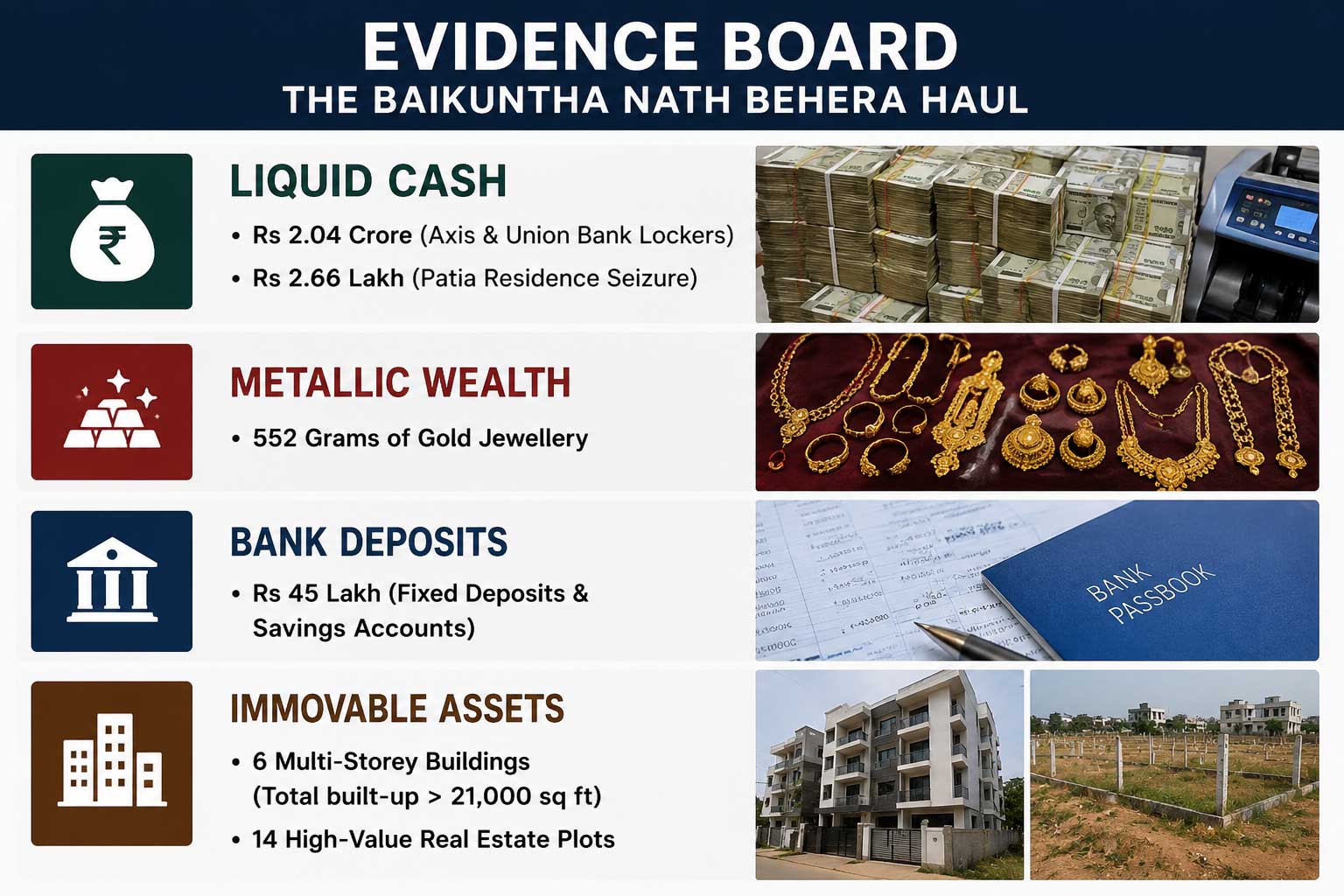
The locker owner was the wife of Baikuntha Nath Behera, a 52-year-old Assistant Executive Engineer (AEE) posted in the remote, forested hills of Kandhamal’s Baliguda division under the Integrated Tribal Development Agency (ITDA). Behera, who had joined public service in 1999 as a stipendiary Junior Engineer on a salary of just Rs 6,000 per month, had accumulated a private property empire valued at 798% above his known, legitimate sources of income.
This investigation reveals how twenty-five years of administrative loopholes, prolonged tribal welfare deputations, and a systemic lack of oversight allowed a mid-level technical officer to build a real estate empire while the indigenous communities he was paid to serve remained in deep poverty.
|
Historical Context: The Birth of ITDA and the Siphoning Pipeline
To understand the scale of Behera’s wealth accumulation, one must examine the administrative structure of tribal development funding in Odisha. Following the Fifth Five-Year Plan (1975–1976), the Government of India established Integrated Tribal Development Projects (ITDP)—later converted to Integrated Tribal Development Agencies (ITDA) between 1979 and 1980—specifically designed to uplift tribal populations.
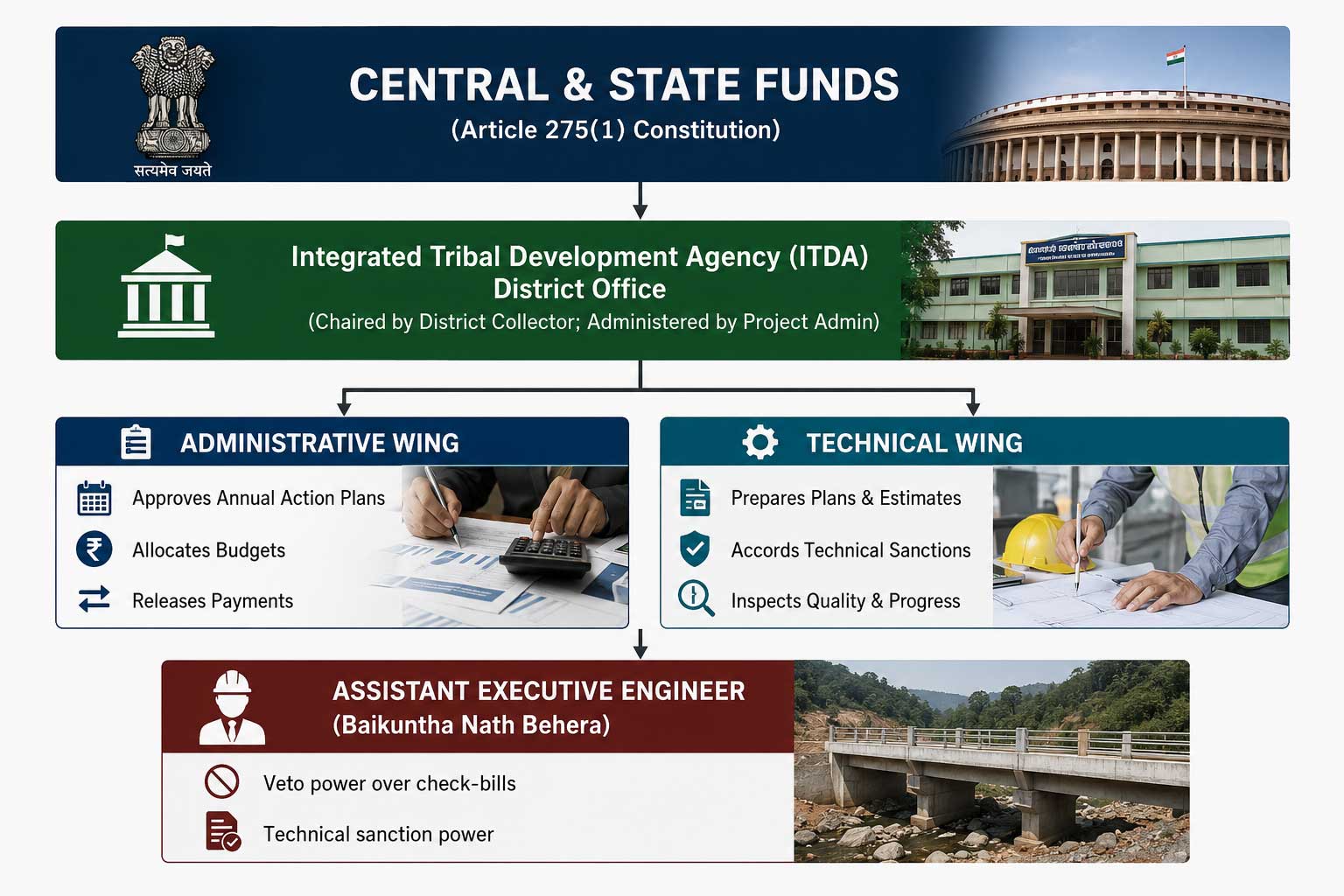
The primary funding vehicle for these agencies is the Tribal Sub-Plan, backed by direct grants-in-aid under Article 275(1) of the Constitution. These resources are meant to fund schools, health clinics, clean water infrastructure, and agricultural development.
However, because the administrative heads of ITDAs—Project Administrators—are typically non-technical administrative officers, they rely completely on the engineering wing for project design, budget estimation, contract awards, and quality certification.
As an Assistant Executive Engineer, Behera occupied a highly lucrative bottleneck in this structure. He held the technical authority to sanction estimates and verify the completion of infrastructure works. This technical veto power enabled him to establish a highly profitable rent-seeking pipeline, channelling a percentage of every public works rupee into private assets.
|
Chronological Journey of Accumulation and Arrest
The rise, consolidation, and eventual collapse of Baikuntha Nath Behera’s financial empire spanned twenty-seven years of public service, unfolding across a series of key milestones:
16 August 1999: Entry into Service (Nabarangpur Block)
Baikuntha Nath Behera enters government service as a Junior Engineer (Civil) under the Nabarangpur district block administration. His starting salary is a modest stipend of Rs 6,000 per month. His primary duties involve basic field-level inspections, preparing initial project measurements, and overseeing rural construction projects.
2001: Deputation to the Tribal Welfare Department
Behera is deputed to the state’s Tribal Welfare Department, starting a continuous 25-year run inside tribal development administrations. This transfer shifts him from standard local government works to the highly flexible, heavily funded ITDA budget pipeline.
October 2016: Promotion to Assistant Engineer
After seventeen years in the field, Behera is promoted to the rank of Assistant Engineer and posted to the ITDA division in Nabarangpur. This promotion increases his project estimation and technical sanctioning limits, giving him deeper oversight over local contractor awards.
12 November 2024: The Unenforced Deputation Directive
The Odisha Works Department issues an official policy memorandum aimed at combating systemic corruption and dismantling contractor-bureaucrat cartels. The directive explicitly mandates:
"The maximum tenure of deputation of an engineer in any borrowing engineering or technical department should not exceed six years."
Despite this clear administrative rule, Behera remains in his tribal welfare posting, bypassing standard rotation policies and continuing to manage local infrastructure funds.
25 February 2026: The Mines Department Bust
The state's anti-corruption landscape is shaken when Odisha Vigilance arrests Debabrata Mohanty, the Deputy Director of Mines for the Cuttack Circle. Caught accepting a routine bribe of Rs 30,000, subsequent raids on Mohanty's properties unearth a record-breaking Rs 4.28 crore in physical cash stashed in laundry bags and cupboards. The arrest signals a hyper-aggressive turn in the state’s anti-corruption posture, leading to a wider crackdown on mid-level technical officials.
12 February 2026: Promotion to Assistant Executive Engineer (Baliguda)
Behera is promoted to Assistant Executive Engineer (AEE) and posted to ITDA Baliguda in the Kandhamal district. In this role, he assumes full technical sanctioning power for projects up to Rs 10 lakh, giving him critical veto power over local public works expenditures. His declared, legitimate monthly salary at this point is approximately Rs 80,000.
5 June 2026: The Pre-Raid Intelligence Trap
Following months of secret surveillance, the Odisha Vigilance Directorate registers a series of corruption cases. The agency traps a regional power section lineman, Dharma Niranjan Chaudhury, in Cuttack for taking bribes, as part of a wider, multi-pronged anti-corruption sweep across several key infrastructure departments.
6 June 2026 (Saturday): The Raid and Cash Discovery
Under search warrants issued by the Special Judge, Vigilance, Bhubaneswar, multiple teams of investigators launch simultaneous raids across nine locations in Bhubaneswar, Jajpur, Mayurbhanj, and Kandhamal.
The operation uncovers a vast asset trail:
At Behera's luxury residence in Patia, officers recover Rs 2.66 lakh in loose cash.
At the Axis Bank and Union Bank of India branches in Chandrasekharpur, investigators open two safe-deposit lockers held in his wife's name, unearthing Rs 2.04 crore in cash.
A third locker reveals 341 grams of gold jewellery (later adjusted during final inventory to 552 grams).
7 June 2026 (Sunday): Arrest and Arraignment
Following a 24-hour interrogation, during which Behera is unable to explain how he accumulated these multi-crore assets on his fixed salary, he is arrested under the Prevention of Corruption Act. Vigilance Superintendent of Police Sushanta Kumar Biswal announces that a forensic evaluation of Behera's finances shows his assets are 798% higher than his known, legitimate sources of income. He is produced before the Special Vigilance Court in Bhubaneswar and remanded to judicial custody.
8 June 2026 (Monday): Opening of Remaining Lockers
Investigators open Behera’s remaining safe-deposit lockers in Bhubaneswar to complete their inventory of his financial assets and property documents. Public debate grows over the state's failure to enforce its 2024 deputation limits, and local activist groups demand a full review of all long-serving technical officers in tribal districts.
|
|
Forensic Asset Portfolio: The Paper Trail of a Hidden Empire
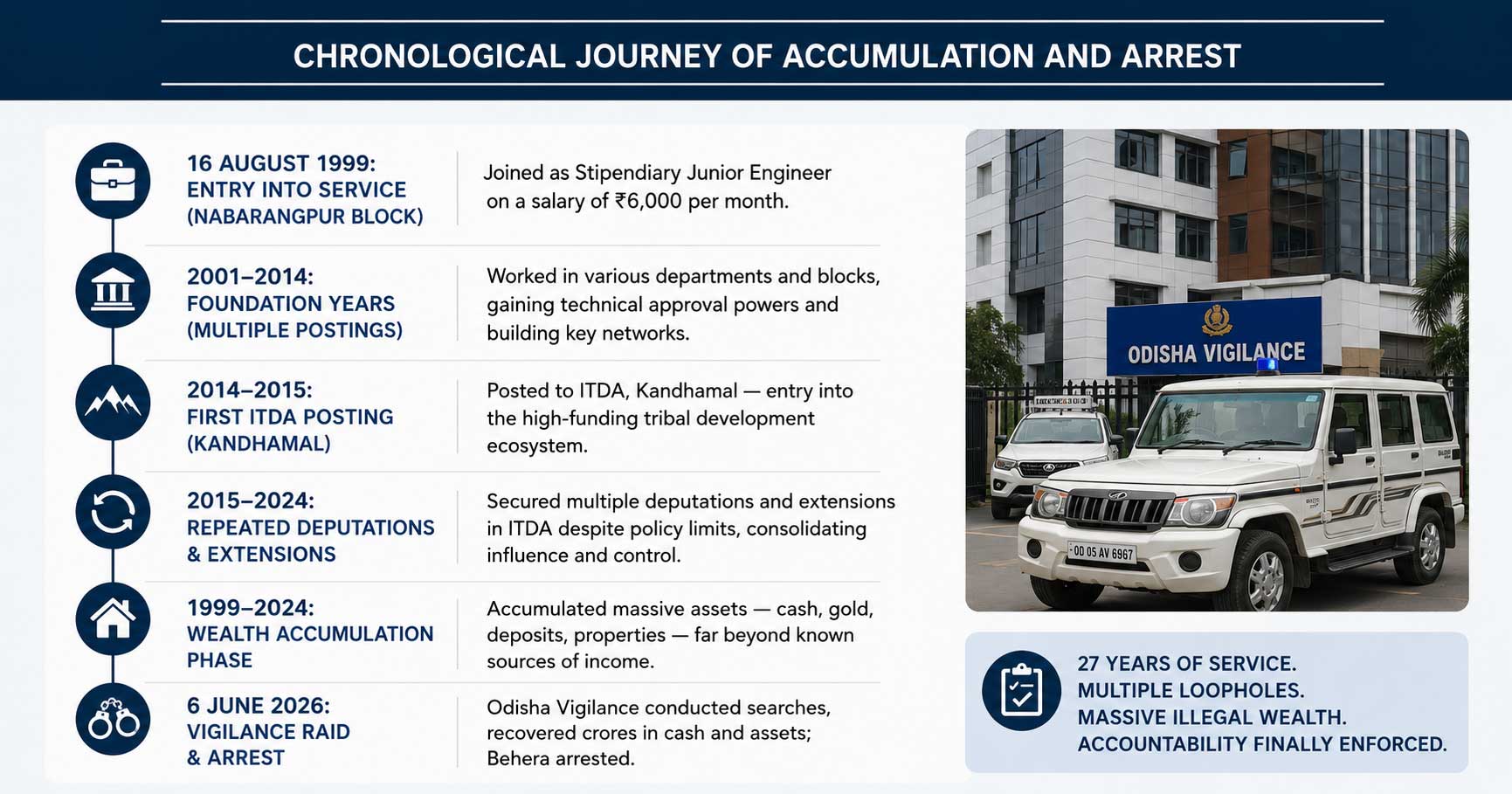
The property trail mapped by the Vigilance Technical Wing reveals a systematic pattern of asset acquisition. Behera concentrated his property purchases in the premium residential corridors of northern Bhubaneswar, while keeping his cash reserves liquid inside secure bank lockers to avoid creating an easily auditable digital footprint.
The following table provides an exhaustive breakdown of the assets detected and evaluated by the investigation team:
Immovable Property Register
| Asset Type & Location | Dimension / Built-up Area | Registered Owner | Forensic & Market Evaluation |
4-Storey Mansion Niladri Vihar, Bhubaneswar | 10,500 sq ft | Spouse (Housewife) | High-end construction located in a premium residential sector. Constructed with premium fixtures, Italian marble, and security systems. |
3-Storey House Sailashree Vihar, Bhubaneswar | 1,100 sq ft | Joint Family | Built as multiple rental units to generate undeclared, off-the-books cash income. |
2-Storey House Patia (Kanan Vihar), Bhubaneswar | 3,750 sq ft | Joint Family | Served as the family's primary urban residence. Site of the initial house search where Rs 2.66 lakh in cash was recovered. |
2-Storey House Chandrasekharpur, Bhubaneswar | 2,500 sq ft | Spouse (Housewife) | Located near commercial areas, representing highly appreciated capital assets. |
2-Storey Residence Pandua, Dharmasala, Jajpur | 2,500 sq ft | Ancestral/Family | Reconstructed on ancestral land using undocumented funds. Used to maintain a modest presence in his home village. |
14 High-Value Real Estate Plots Bhubaneswar, Jajpur, Baripada | Various premium parcels | Behera, Spouse, & Benami entities | Distributed across fast-developing urban zones including Govindprasad, Bomikhal, Ghatikia, Jatni, and Dharmasala. |
Movable & Liquid Assets
| Asset Class | Quantum / Valued Amount | Storage Facility | Investigation Significance |
| Physical Cash (Lockers) | Rs 2,04,00,000 | Axis Bank & Union Bank, Chandrasekharpur | Held in bundles of Rs 500 notes. Kept completely out of the digital banking system to avoid automated tax audits. |
| Physical Cash (Residential) | Rs 2,66,000 | Patia Residence, Bhubaneswar | Recovered from a household drawer during the initial phase of the raids. |
| Gold Jewellery | 552 Grams | Safe-Deposit Vaults | High-purity gold ornaments, serving as a reliable hedge against currency depreciation. |
| Fixed Deposits & Savings | Rs 45,00,000 | Multiple Bank Accounts | Spread across multiple commercial banks. Currently frozen under the Prevention of Corruption Act. |
Systemic Sclerosis: The Deputation Loophole and Tribal Exploitation
The case of Baikuntha Nath Behera is not merely a story of individual greed; it exposes a structural failure within Odisha’s rural administrative machinery.
The primary loophole that enabled Behera’s wealth accumulation was his uninterrupted 25-year tenure within the Tribal Welfare Department. In typical state administrations, technical officers in high-discretion departments are subject to mandatory rotation policies every three to four years to prevent the consolidation of corrupt local networks.
Despite the Works Department’s November 2024 memorandum explicitly capping engineer deputations to external borrowing departments at a maximum of six years, Behera was left in his post. This systemic failure to enforce rotation policies is a common vulnerability across Odisha’s tribal welfare programs, allowing long-serving technical officers to build highly lucrative local monopolies.
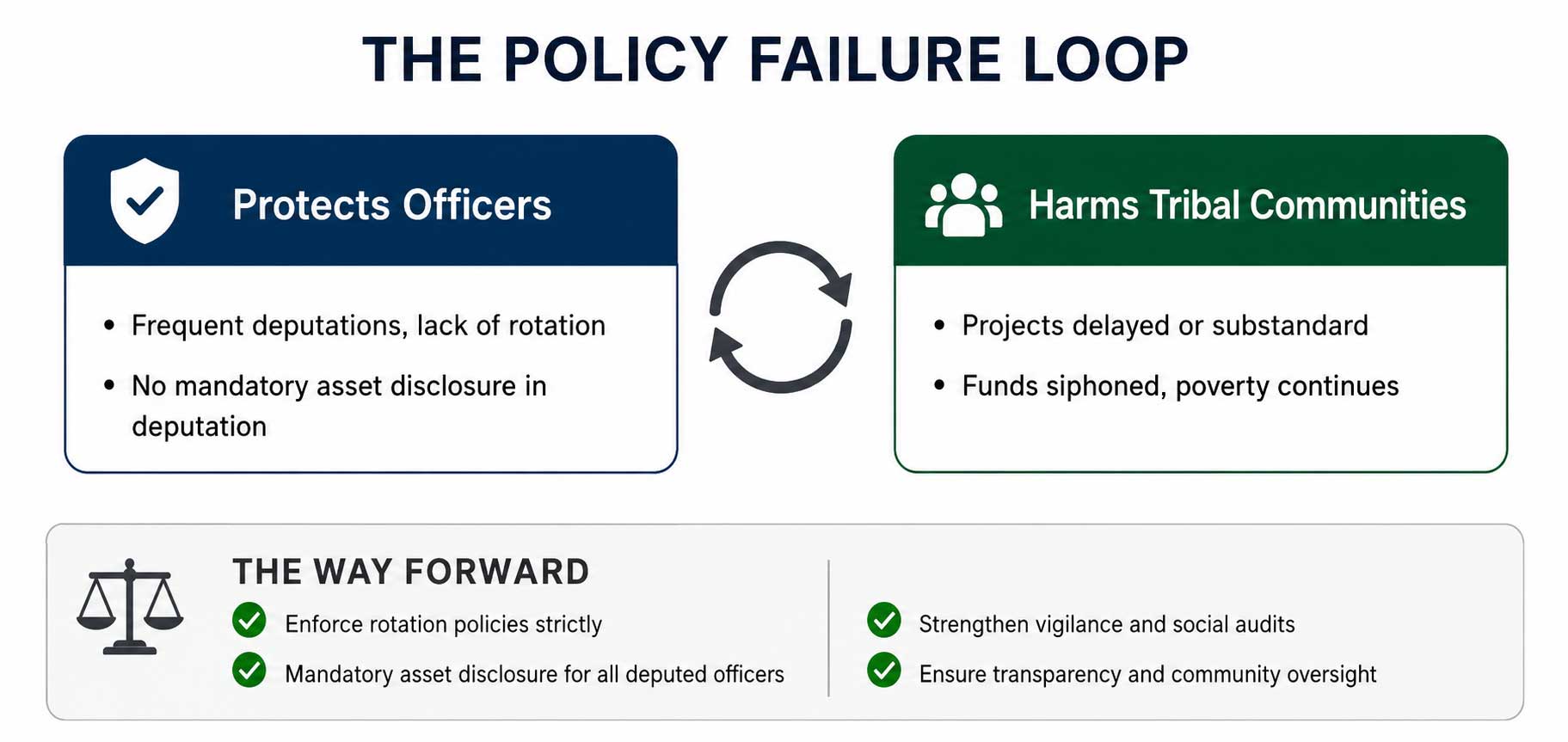
Ajit Patra, a prominent tribal welfare campaigner and former president of the Koraput Bar Association, explained how this administrative failure directly impacts marginalized communities:
"The continuous deputation of engineering officers to the same tribal development departments for fifteen, twenty, or twenty-five years creates deeply entrenched local cartels. These technical officers build close, long-term relationships with local contractors, politicians, and administrative supervisors. As a result, the check-and-balance systems designed to protect public funds are completely neutralized. The actual victims are the tribal communities, who are left with sub-standard schools, incomplete road networks, and non-functional water projects."
|
|
Confirmed Facts versus Disputed Claims
To maintain the factual accuracy required of a high-level investigation, it is necessary to clearly separate confirmed forensic findings from allegations and defense narratives:
| Confirmed Forensic Evidence | Defense Claims & Legal Contentions | Unverified Investigation Leads |
Physical Cash Seizure: Rs 2.04 crore was physically recovered from Axis Bank and Union Bank safe-deposit lockers held in his wife's name. | Spouse’s Business Claims: The defense plans to argue that a portion of the stashed cash represents legitimate savings, household gifts, and family assets. | Political Kickback Network: Investigators are examining whether Behera served as a financial conduit, passing siphoned tribal funds up to higher-level administrative and political patrons. |
798% Disproportionate Assets: A formal financial evaluation shows Behera’s properties and bank deposits far exceed his career earnings as a government engineer. | Technical Value Disputes: Behera's legal team intends to challenge the Technical Wing’s real estate valuations, arguing that the market assessments of his properties are inflated. | Undeclared Assets: Vigilance officers suspect Behera may hold additional benami real estate parcels in Jajpur and Mayurbhanj under the names of extended relatives. |
Deputation Policy Violation: Official personnel files confirm Behera served continuously in the Tribal Welfare Department since 2001, in violation of the 2024 policy directive. | Administrative Justification: The defense contends that his long tenure was the result of official state deployment orders and a shortage of qualified technical staff in tribal districts. | Contractor Syndicate Cartels: The agency is reviewing several past ITDA construction contracts in Baliguda to determine if specific contractor cartels systematically paid kickbacks to Behera. |
The Broader Picture: Odisha's War on Hard Cash
The unearthing of Behera’s millions is part of a wider, systemic pattern of corruption currently being uncovered across Odisha’s public works and resource departments. High-level corruption in the state is rarely characterized by complex offshore shell companies. Instead, it relies on physical cash.
Like the Mines Department’s Debabrata Mohanty—who deliberately kept his entire fortune in liquid cash to avoid creating an auditable digital trail of benami land purchases—Behera systematically converted his siphoned funds into physical assets: premium properties in Bhubaneswar, physical gold, and piles of cash locked in bank vaults.
To counter this, the Odisha Vigilance Directorate underwent a major technological upgrade, establishing a dedicated Artificial Intelligence (AI) Cell at its headquarters in Cuttack in late October 2025. Assisted by cybersecurity experts and software engineers from IIT-Bhubaneswar and the National Informatics Centre (NIC), the cell uses advanced analytical tools to identify systemic corruption patterns:
Automated Asset Mapping: Algorithms systematically scan state property registries, identifying sudden, unexplained luxury real estate purchases by government employees and their immediate family members.
Digital Footprint Analysis: The cell tracks and cross-references bank deposits, automated tax filings, and insurance portfolios to flag anomalies in wealth accumulation.
Predictive Risk Profiling: By analyzing long-standing tenures in high-budget, high-discretion departments, the AI system flags technical officers who have overstayed their rotation timelines.
In Behera’s case, these digital analysis tools played a key role. Long before the physical raids were launched, the AI Cell flagged the irregular concentration of premium real estate purchases in Bhubaneswar registered under his housewife spouse’s name, giving the search teams the precise intelligence needed to target his safe-deposit lockers on 6 June 2026.
|
Unresolved Questions and Governance Mandate
The arrest of Baikuntha Nath Behera represents a significant success for Odisha's anti-graft forces, but it leaves several critical governance questions unanswered.
The most urgent issue is the complete lack of administrative accountability for the supervisors who allowed Behera to bypass rotation policies for nearly twenty-five years. How did a mid-level technical officer manage to ignore the explicit, department-wide 2024 deputation limits?
The failure to enforce these guidelines suggests a broader pattern of systemic administrative compliance, where personal connections and political patronage can easily bypass official anti-corruption directives.
Furthermore, the case highlights the extreme vulnerability of tribal development funds in remote districts. The Integrated Tribal Development Agencies receive substantial funding intended to provide basic services to marginalized communities. Yet, the technical sanctioning and billing pipelines designed to implement these programs have instead been co-opted to enrich corrupt officials.
Until the state implements deep, structural administrative reforms—including automated rotation systems, mandatory annual asset disclosures, and independent, third-party technical audits of development works—the root causes of this systemic corruption will remain unaddressed. Without these structural changes, high-profile raids will remain a temporary deterrent, rather than the turning point Odisha's public administration so urgently needs.
|
 Support Us
Satyagraha was born from the heart of our land, with an undying aim to unveil the true essence of Bharat. It seeks to illuminate the hidden tales of our valiant freedom fighters and the rich chronicles that haven't yet sung their complete melody in the mainstream.
While platforms like NDTV and 'The Wire' effortlessly garner funds under the banner of safeguarding democracy, we at Satyagraha walk a different path. Our strength and resonance come from you. In this journey to weave a stronger Bharat, every little contribution amplifies our voice. Let's come together, contribute as you can, and champion the true spirit of our nation.
 |  |  |
| ICICI Bank of Satyaagrah | Razorpay Bank of Satyaagrah | PayPal Bank of Satyaagrah - For International Payments |
If all above doesn't work, then try the LINK below:
DISCLAIMER: The author is solely responsible for the views expressed in this article. The author carries the responsibility for citing and/or licensing of images utilized within the text. The website also frequently uses non-commercial images for representational purposes only in line with the article. We are not responsible for the authenticity of such images. If some images have a copyright issue, we request the person/entity to contact us at This email address is being protected from spambots. You need JavaScript enabled to view it. and we will take the necessary actions to resolve the issue.


